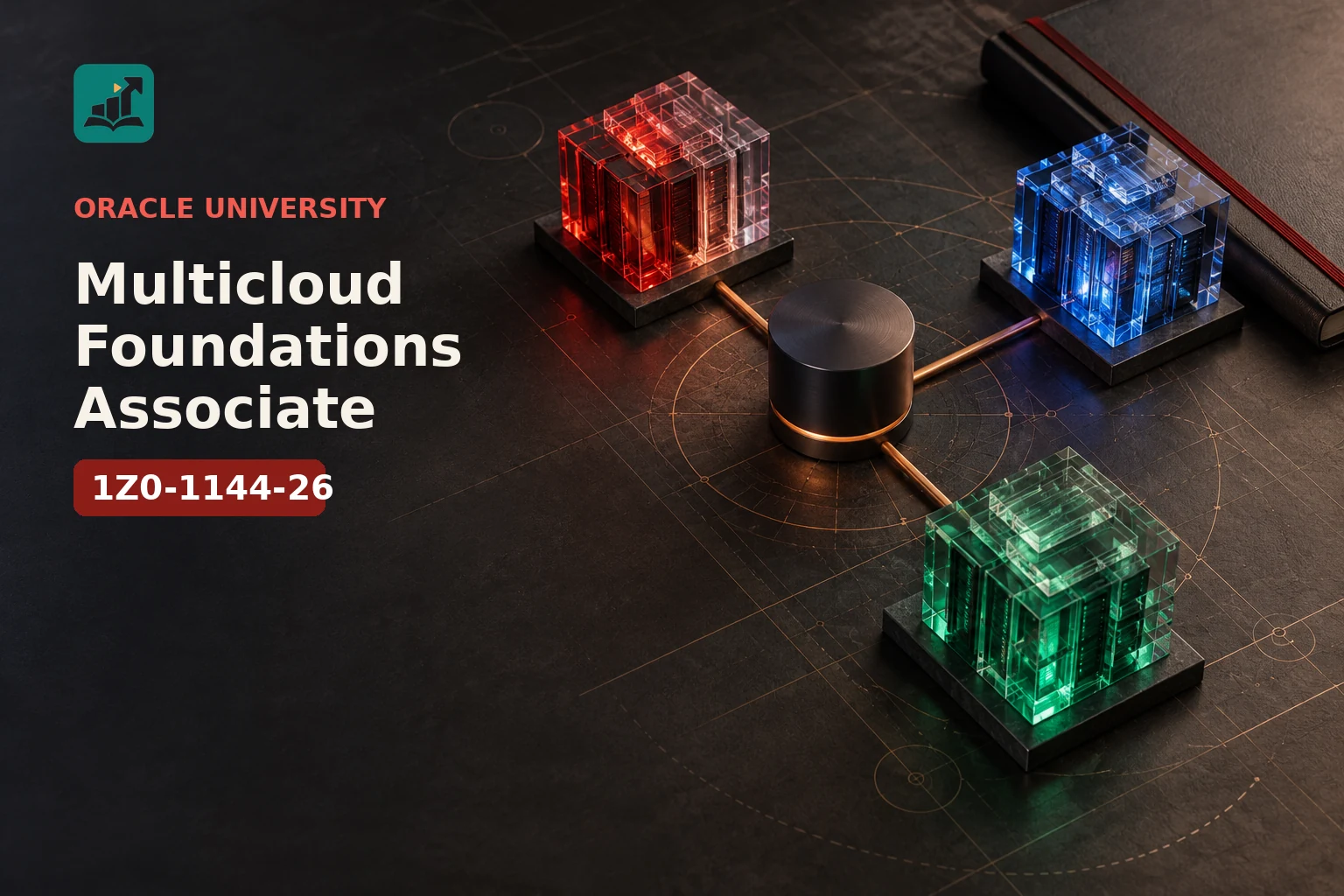
Oracle University announced the availability of the Oracle Multicloud Foundations Associate learning path and certification on October 20, 2026. The new exam code is 1Z0-1144-26. It targets technical and non-technical learners, requires no prior hands-on experience, and validates the foundations needed to understand Oracle AI Database across AWS, Google Cloud, and Microsoft Azure.
This is more than a quiet catalog refresh. In August, Oracle described Multicloud Foundations as a certification planned for September 2026. The official October 20 availability announcement (opens in a new tab) now confirms the course, blueprint, code, format, and passing score. Candidates can therefore move from watching a roadmap item to preparing against a published exam.
Confirmed details for exam 1Z0-1144-26
| Item | Official information |
|---|---|
| Certification | Oracle Multicloud Certified Foundations Associate |
| Exam | Oracle Multicloud Foundations Associate |
| Code | 1Z0-1144-26 |
| Format | 40 multiple-choice questions |
| Duration | 60 minutes |
| Passing score | 65% |
| Required hands-on experience | None |
| Audience | Technical and non-technical professionals |
| Environments | Oracle AI Database@AWS, @Google Cloud, and @Azure |
Oracle recommends completing the learning path, reviewing the objectives, and using the free practice exam before attempting the certification. The official entry points are the Oracle MyLearn learning path (opens in a new tab) and the 1Z0-1144-26 exam page (opens in a new tab).
“Foundations” matters here. The credential does not validate deep Exadata administration or detailed multicloud network engineering. It checks whether a candidate can explain the offerings, architecture, onboarding, database lifecycle, resilience, migration, and security at a foundational level.
Six objectives and their weightings
The official blueprint divides the exam into six objectives. The three central areas account for 60% of the blueprint.
| Objective | Weight |
|---|---|
| Explain Oracle Multicloud Solutions | 10% |
| Understand Multicloud Architecture | 20% |
| Onboarding Foundations for Oracle AI Database@CSP | 20% |
| Describe Database Services and Lifecycle Management | 20% |
| Explain Data Resilience and High Availability | 15% |
| Explain Migration and Security | 15% |
This distribution sets a clear priority. A preparation plan limited to a commercial comparison of AWS, Azure, and Google Cloud will not be enough. Most study time should go to how Oracle AI Database@CSP is architected, activated, and operated.
The percentages do not guarantee an exact number of questions in each domain. With 40 questions, converting percentages into estimated question counts can help allocate study time, but it cannot predict a specific delivery. Treat the weights as a planning tool, not as an exam formula.
What the learning path actually covers
The course contains six modules that follow the exam structure.
1. Multicloud concepts and use cases
The first module positions Oracle’s offerings within a multicloud strategy. A candidate should be able to explain why an organization might keep applications or analytics services in a hyperscaler while using Oracle AI Database capabilities. The task is not to repeat generic cloud benefits. It is to understand where Oracle’s services fit in a distributed environment.
2. Architecture and interconnects
The second module introduces Oracle AI Database@CSP architecture and multicloud interconnect architecture. Build your own conceptual diagram that separates the management plane, the database service location, connectivity paths, and each provider’s responsibilities. The Foundations exam does not turn learners into network engineers, but it still rewards precise terminology.
3. Onboarding, access, and consumption
Onboarding includes roles, permissions, access requirements, activation steps, private and public offers, billing, and consumption. This objective is easy to underestimate because it joins identity, technical setup, and commercial mechanics. A useful study exercise is a timeline: who accepts an offer, who grants access, who provisions the service, and where consumption becomes visible.
4. Database services and lifecycle
Oracle names three service families: Autonomous AI Database, Exadata Database Service, and Base Database Service. Candidates need to recognize their roles and the foundations of provisioning, connectivity, management, and monitoring. For a deeper operational route, the French OnLevelUp guide to the Oracle Exadata Professional path and exam 1Z0-1193-26 covers a separate, advanced credential.
5. Resilience and high availability
The learning path introduces backup and restore, Autonomous Recovery Service, and Oracle Maximum Availability Architecture. Link every mechanism to a requirement: recovering from an error, maintaining availability, or planning disaster recovery. Memorizing product names without the risk each one addresses is a weak preparation strategy.
6. Migration and security
The final module introduces migration approaches, including Zero Downtime Migration (ZDM), plus data protection and security configuration. At Foundations level, candidates should be able to select a coherent approach and recognize safeguards, rather than reproduce a complete migration runbook.
A three-step preparation plan
Step 1: build a service map
Start with the six modules and create one sheet per objective. Record the actors, Oracle resources, hyperscaler, and expected outcome. Add an AWS, Azure, and Google Cloud example so that your preparation does not reflect only the environment you use at work.
The credential can complement a broader cloud roadmap. If AWS is already part of your plan, the OnLevelUp AWS AI certification path for 2026 helps separate AWS-specific skills from genuinely multicloud concepts.
Step 2: practice comparison instead of isolated recall
For every database service, answer four questions:
- Where is the service delivered?
- How does a team obtain access?
- How do applications connect to it?
- Which options protect and move the data?
Then work through scenarios. One organization wants to keep an application in Azure while placing Oracle data close to it; another needs to protect a critical database and define recovery. Your answer should identify the service family, connectivity, and resilience considerations without inventing implementation details that are absent from the blueprint.
Step 3: use the practice exam diagnostically
Take the practice exam after completing a first pass through all six modules. Classify each missed question under the official objectives. If errors cluster around onboarding and architecture, address them first: together those areas already represent 40% of the blueprint.
Finish with a timed 60-minute simulation. Forty questions produce a mathematical average of 90 seconds per question. That is a personal pacing reference, not an Oracle rule. Preserve time to reread prompts that mix the Oracle service, the hyperscaler, and responsibility boundaries.
Who benefits most?
The learning path suits cloud beginners, database professionals, architects, and IT engineers who need to understand Oracle options across several providers. It can also support business professionals involved in service selection, onboarding, or cloud consumption.
An experienced Oracle administrator may find the technical depth introductory. The value is then a structured AWS–Azure–Google Cloud view before selecting a Professional credential. A complete beginner should first review basic cloud, networking, and database concepts. Oracle does not require hands-on experience, but says that foundational cloud and database knowledge is helpful.
What the certification does not replace
Exam 1Z0-1144-26 is not an advanced administration badge and does not replace provider-specific expertise. It also does not prove that someone has deployed a production architecture. It validates a structured understanding of the offerings and foundational decisions.
That distinction should remain clear on a résumé. Present the credential as an Oracle multicloud foundation, then add projects or technical certifications that demonstrate execution. A small documented lab—architecture, connectivity choice, backup approach, and migration plan—adds more evidence than a product list.
FAQ
Is the certification actually available?
Yes. Oracle University announced it as “Now Available” on October 20, 2026 and links to the learning path, practice exam, and 1Z0-1144-26 exam.
Is hands-on experience required?
Oracle says no hands-on experience is required. Basic cloud and database knowledge is still useful.
Are the course and exam the same product?
No. The course structures the material in six modules. The 40-question exam validates that knowledge and requires a 65% score.
Is the certification tied to one cloud?
No. The blueprint covers Oracle AI Database@AWS, Oracle AI Database@Google Cloud, and Oracle AI Database@Azure. Preparation should compare all three rather than focus on one provider.
Before registering, verify the conditions shown in Oracle MyLearn for your account and region. The announcement establishes the blueprint and format; the exam platform remains the operational source for access and scheduling.