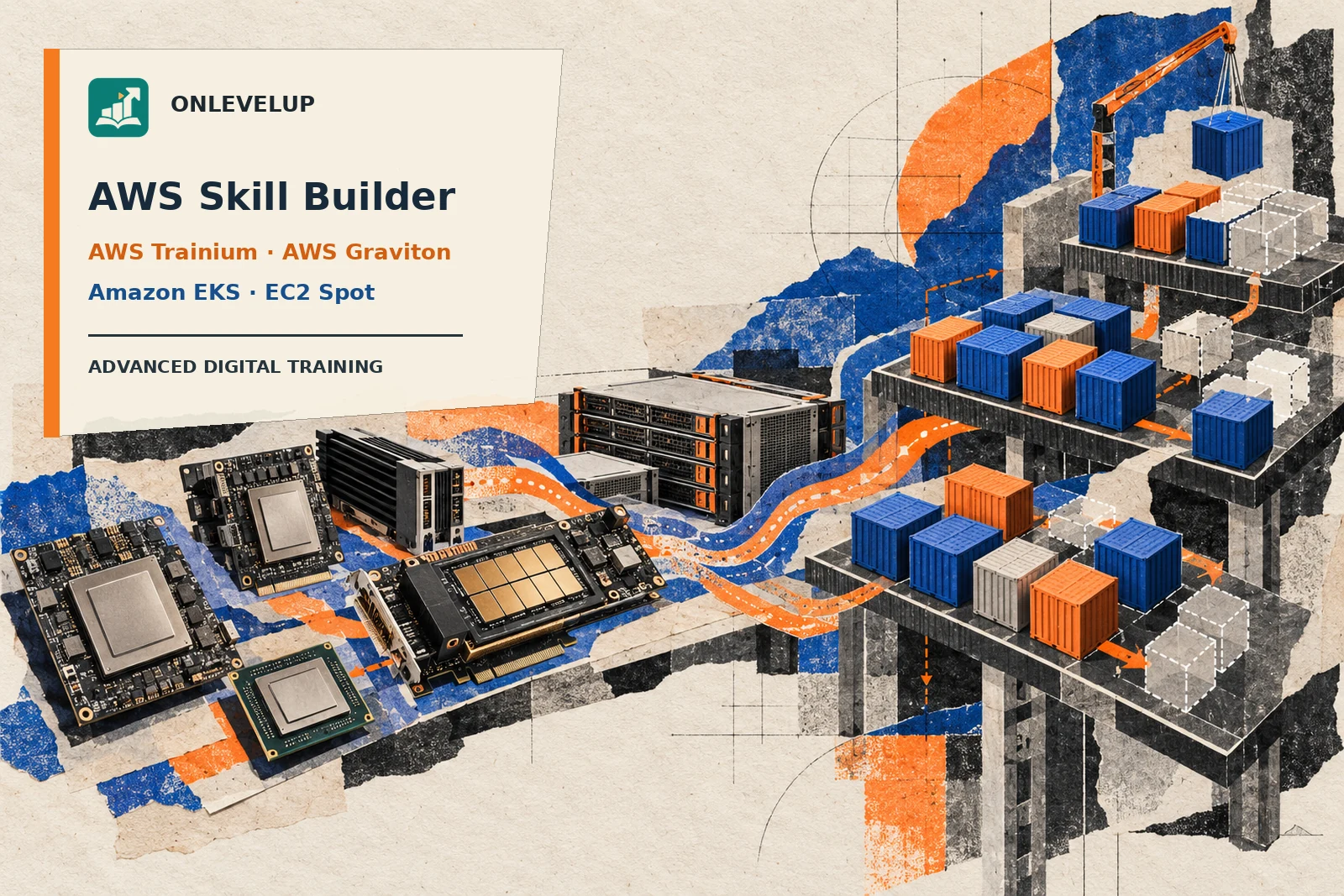
AWS published two new advanced digital courses in AWS Skill Builder on October 20, 2026. The first teaches learners how to choose compute hardware for different stages of an artificial intelligence pipeline. The second combines EKS Auto Mode, Graviton processors, and Spot Instances to reduce cost and simplify Kubernetes operations.
These courses do not create a new certification and do not, by themselves, award an AWS Certified credential. Their value is more focused: they cover concrete technical decisions that can strengthen advanced preparation in cloud architecture, machine learning, or container platforms. Learners should use them as targeted practice modules without presenting them as a standalone certification path.
Two free courses for two different decisions
The official AWS Training and Certification announcement dated October 20, 2026 (opens in a new tab) lists two courses available at no cost:
| Course | Level | Duration | Main decision practised |
|---|---|---|---|
| Assembling the Complete AI Stack — Optimizing Your AI Hardware on AWS | Advanced | 2 hours | Select compute by AI pipeline stage, model size, capacity, and cost. |
| Boost Amazon EKS Efficiency — EKS Auto Mode, AWS Graviton, and Amazon EC2 Spot | Advanced | 1.5 hours | Combine automation, processor architecture, and interruptible capacity to operate EKS efficiently. |
AWS targets decision-makers, developers, cloud architects, cloud operators, DevOps engineers, machine learning engineers, and platform engineers. “Advanced” describes the course level; the announcement does not publish a formal prerequisite. Before starting, however, you should be able to explain an EC2 instance, a container, a Kubernetes cluster, and the difference between training and inference.
The direct Skill Builder enrolment pages are available for the AI hardware course (opens in a new tab) and the EKS efficiency course (opens in a new tab). The application requires JavaScript, so confirm regional availability and any updated access terms in your account.
Course 1: choose compute across the AI stack
The first course goes beyond a GPU-versus-CPU comparison. It provides a decision framework for stages ranging from data processing and training to inference and application deployment. Its outline names AWS Graviton, AWS Trainium, AWS Inferentia, GPU-based instances, and instances powered by Intel or AMD processors.
The important objective is to avoid applying one rule to every workload. A team may need one environment for preparing data, another for training or customising a model, and another for serving requests under a latency target. Available capacity, cost, model size, throughput, and software compatibility all affect the answer.
AWS lists seven sections: the AWS AI stack, a model-size decision framework, EC2 cost and capacity planning, assembling the pipeline, and three practical scenarios involving an internal assistant, startup inference deployment, and model customisation.
To turn the two-hour course into durable learning, prepare a simple matrix beforehand: pipeline stage, data or model size, latency target, run duration, interruption tolerance, and budget. During every scenario, record what would make you change instance family. Afterward, justify one selected option and one rejected option.
This prevents the course from becoming a catalogue of chip names. It produces a reviewable statement: “For this inference workload, we selected this capability because the dominant constraint is X; we would accept Y if the volume changed.” That kind of reasoning remains useful in architect and ML engineer preparation.
Course 2: operate EKS with three complementary levers
The second course brings together EKS Auto Mode, AWS Graviton, and Amazon EC2 Spot Instances. Each affects a different dimension: cluster infrastructure automation, processor price-performance, and access to unused EC2 capacity that can be interrupted.
The outline covers EC2 characteristics for containers, EKS Auto Mode, Kubernetes scaling mechanisms, Graviton for container workloads, Spot Instances, and a demonstration. AWS also says learners will explore moving workloads to Graviton and handling Spot interruptions gracefully.
The combination only works when the application supports it. A container image must be compatible with the target architecture. A workload on Spot must tolerate capacity loss and recover without corruption. Scaling must reflect useful metrics, while automation does not remove the need to observe placement, limits, and cost.
Prepare a small exercise containing a stateless service and a work queue. First identify which work can be interrupted. Then check image compatibility, resource requests and limits, distribution rules, termination signals, and recovery strategy. Finally, define metrics that could compare cost per request or completed job.
The exercise remains useful without deploying an expensive workload. You can produce a plan, a minimal manifest, and a control checklist, then explain the risks. The objective is not to claim hypothetical savings; it is to show why an architecture could reduce cost without reducing the required reliability.
Connect the courses to an AWS certification
AWS does not describe these courses as exclusive official preparation for one exam. They can still complement several paths because they practise design, operations, and optimisation decisions. Decide where they fit by starting with your certification’s official exam guide, not with an appealing course title.
If your target is AI, the published OnLevelUp guide to the AWS AI certification path in 2026 separates AI Practitioner, Machine Learning Engineer, and Generative AI Developer. The hardware course is most relevant when the target role must reason about training, inference, capacity, and cost. It goes beyond an introduction to AI terminology.
The EKS course becomes relevant when the blueprint expects you to design or operate containerised architectures, optimise resources, or manage resilience. It does not replace Kubernetes fundamentals. Objects, scheduling, networking, storage, observability, and security must already be understood or studied separately.
The Microsoft AI certification overview illustrates another useful distinction: credentials validate different job roles and levels. Apply the same discipline here. A completed course, a possible course badge, a hands-on microcredential, and a proctored AWS Certification are not interchangeable claims on a résumé.
A four-session study plan
Session 1: baseline diagnosis
Before watching anything, write down what you would choose for an AI pipeline and an EKS cluster. List assumptions and missing data. This baseline lets you measure a change in reasoning rather than only a course completion percentage.
Session 2: AI hardware course
Complete the two hours while updating your decision matrix. For each of the three announced scenarios, record the pipeline stage, compute need, capacity constraint, and financial risk. If an answer depends on a missing measurement, mark it as an assumption rather than inventing a number.
Session 3: EKS course
Connect every mechanism to a usage condition. Auto Mode reduces some operational work; it does not remove application responsibility. Graviton requires compatibility. Spot requires interruption tolerance. Scaling requires coherent signals and thresholds.
Session 4: cross-review
Design an architecture combining an inference API and asynchronous processing. Decide which parts could run on Graviton or Spot, then describe how you would observe cost, latency, errors, and capacity. Finish with a short note identifying what cannot be concluded without a real test.
Common mistakes to avoid
The first mistake is assuming specialised hardware is always cheaper. Cost depends on run duration, utilisation, data transfer, regional availability, and software. The second is treating Spot as a discount without a trade-off. An interruption that is handled badly can cost more than the expected saving.
The third is confusing automation with zero operations. EKS Auto Mode can simplify infrastructure management, but the team must still define workloads, policies, security, and observability correctly. The fourth is claiming certification after finishing a free course. The accurate résumé statement is “completed AWS Skill Builder training,” accompanied by a project or review when the account confirms completion.
Should you take the courses now?
Yes, if you expect to make decisions about AI compute, inference, or EKS operations soon and already have the necessary foundations. With a total of three and a half hours of content and access announced as free, the cost of exploration is limited.
Start with fundamentals instead if instance types, processor architecture, pods, nodes, or Spot interruption are not yet clear. Advanced content taken too early often produces a memorised service list without diagnostic ability.
The strongest outcome from these courses is not another line on a profile. It is a framework for explaining why a compute option, capacity model, or deployment strategy fits a given workload. Check the Skill Builder pages when enrolling, then connect every module to a specific certification objective or project decision.